

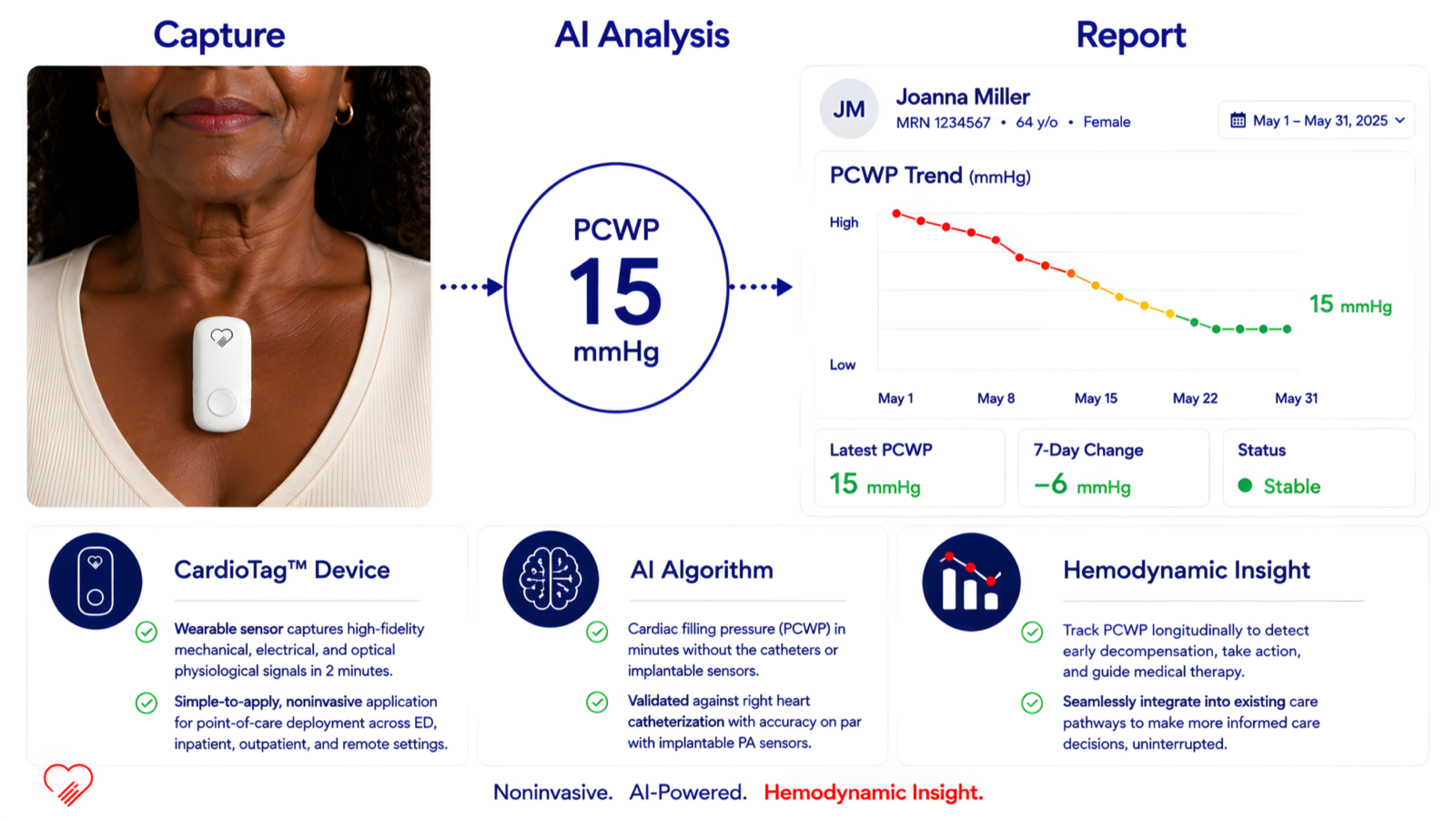
Every forty seconds, somewhere in the United States, a person with heart failure begins to retain the fluid that will eventually send them to a hospital. The warning sign appears days, sometimes weeks, before they feel short of breath: a rising pressure deep inside the heart. Until now, the only way to read that pressure was to thread a catheter into the pulmonary artery or implant a sensor in the chest. Cardiosense changed that. Getting a first‑of‑its‑kind technology safely into clinicians’ hands took as much regulatory science as it did sensors and algorithms.
On May 27, 2026, Cardiosense announced that the U.S. Food & Drug Administration had granted De Novo classification to its PCWP Analysis Software™: the first noninvasive, AI‑powered tool ever authorized to estimate a patient’s pulmonary capillary wedge pressure, a critical indicator of heart health that previously required an invasive procedure. It was the culmination of nearly two decades of multidisciplinary research, a rigorous multi‑center clinical study, and a sustained, evidence‑driven collaboration with the FDA’s cardiovascular device experts.
This is the story of how that device was built to be safe and effective, and of the regulatory and clinical‑science discipline that made it real for doctors and patients.
Six million patients, and a pressure no one could see
Heart failure affects an estimated 6 million American adults, and the number keeps climbing as the population ages. It is one of the leading causes of hospitalization in people over 65, and the single most expensive condition for the U.S. healthcare system. The cruelty of the disease is in its rhythm: patients feel stable, then deteriorate, then land in the emergency department, over and over.
The hidden driver of that cycle is congestion: a buildup of fluid that overloads the heart and lungs. The most reliable early signal of congestion is a measurement called pulmonary capillary wedge pressure (PCWP): the filling pressure on the left side of the heart. When PCWP rises, the body is heading toward decompensation. That rise often begins well before a patient feels anything at all, which opens a window in which a clinician could adjust medication and prevent a hospitalization entirely.
The problem was access. PCWP could only be obtained two ways: with a catheter placed inside the heart during a right‑heart catheterization, or with a pressure sensor surgically implanted in the pulmonary artery. Both are invasive and expensive, and neither can be repeated day after day. For the vast majority of the 6 million, the most important number in their disease was invisible.
Two decades of signal, fused into a single sensor
Cardiosense was built on nearly twenty years of clinical and engineering research into the physiological vibrations of the heart. At its foundation is seismocardiography (SCG), the science of measuring the tiny mechanical movements the heart produces with every beat, captured from the surface of the chest. Read alongside two more familiar signals (the electrocardiogram (ECG), which captures the heart’s electrical activity, and the photoplethysmogram (PPG), which captures blood flow), SCG shows how the heart’s mechanics, its electrical timing and the movement of blood relate to one another. Those relationships encode pressure.
The hardware that captures all three at once is the CardioTag™ device (FDA cleared on July 30, 2025), the first multimodal wearable sensor to record high‑fidelity ECG, PPG and SCG simultaneously from a single patch worn on the chest, from hospital to home. Turning those raw waveforms into a clinical number is the job of Cardiosense’s Clinical AI: deep‑learning algorithms that translate physiological signals into digital biomarkers predictive of heart failure, hemodynamic instability and other forms of cardiac dysfunction.
A noninvasive sensor, measured against the invasive gold standard
In the prospective, multi‑center SEISMIC‑HF I study, Cardiosense’s machine‑learning algorithm was developed and evaluated in 310 patients with heart failure with reduced ejection fraction (HFrEF), each undergoing right‑heart catheterization, the invasive reference standard for PCWP. The cohort was deliberately diverse, reflecting the broader heart‑failure population. The results, published in JACC: Heart Failure and presented at the American Heart Association’s 2024 Scientific Sessions, showed accuracy comparable to implanted pressure sensors. Follow‑on analyses at TCT 2025 and AHA 2025 suggested the algorithm can even exceed the standard physical exam at noninvasively assessing congestion at the point of care.
That phrase, comparable to implanted pressure sensors, is what separates an interesting research signal from a device a cardiologist will trust. Turning that signal into a number the FDA will authorize for clinical use is less an engineering problem than a problem of regulatory strategy and clinical study design.
How a model becomes a medicine
An AI model that performs well on a research dataset is a long way from a device that is safe and effective in the real world. Closing that gap is the core of the regulatory and clinical work, and it draws on two disciplines at once: regulatory strategy and clinical study design.
Designing the clinical evidence
The validation strategy had to answer the FDA’s central question for any diagnostic: does this number mean what you say it means, in the patients you intend to use it on? That meant designing SEISMIC‑HF I so the algorithm’s output could be compared head‑to‑head with simultaneous invasive PCWP: defining the reference standard, the agreement metrics, the acceptance criteria and the statistical plan up front. It meant enrolling a population diverse enough in age, sex, body habitus, and comorbidity that performance could be shown to generalize rather than reflect a narrow training set. And it meant separating the data used to train the model from the data used to test it, so the evidence the FDA reviewed was a true measure of future performance, not a memorized one.
Analytical and clinical validation
The dossier paired analytical validation (does the algorithm compute the value reliably and reproducibly across devices, signal quality and conditions?) with clinical validation (does that value correspond to the patient’s true physiology and support the intended clinical decision?). Bridging the two is the discipline that defines modern Software‑as‑a‑Medical‑Device (SaMD) review, and it is the evidence architecture a regulatory function has to build before a single page is submitted.
Writing the indication
The authorized Indications for Use are the contract between the company, the FDA, and the practicing clinician. Per the authorized De Novo, the PCWP Analysis Software is indicated to noninvasively estimate PCWP and identify patients with a PCWP above or below 18 mmHg, for adults with HFrEF and NYHA functional Class II, III, or IV symptoms, for adjunctive use by a qualified clinician alongside other standard‑of‑care parameters, never as the sole basis for a management decision. Each clause fixes the population and the decision context in which the evidence supports safe and effective use. Drafting it broad enough to help patients and narrow enough to be true is regulatory craft.
The quality foundation
None of it holds without a quality system underneath. Cardiosense operates under a Quality Management System compliant with 21 CFR Part 820 and ISO 13485: the design controls, risk management and traceability that make the organization behind the device auditable, not only its submission.
“A clinical algorithm doesn’t become trustworthy at the moment it’s accurate. It becomes trustworthy when you can show, with pre‑specified evidence, in the right patients, under a quality system, that it will keep being accurate. The work of the regulatory function is to design that proof before we ever ask the FDA to review it.”
Building a new device type with CDRH’s cardiovascular team
Because no noninvasive PCWP device had ever existed, there was no predicate, no previously cleared product to point to and say “we are like that.” A device with no predicate cannot take the most common path to market, the 510(k). It needs a pathway built for genuinely novel, low‑to‑moderate‑risk technology: the De Novo classification request.
De Novo is one of the FDA’s most demanding and most consequential pathways. It does not merely authorize a single product; it asks the FDA to create an entirely new device classification and to write the special controls (the specific testing, labeling and performance requirements) that every future device of this type will have to meet. Cardiosense and the FDA were defining a category, not clearing a product. The work established the predicate against which the next generation of noninvasive cardiac‑pressure devices will be measured.
That kind of authorization is impossible without a real, iterative dialogue with the agency. Cardiosense engaged the cardiovascular device experts within the FDA’s Center for Devices and Radiological Health (CDRH), the cardiology‑focused review team in CDRH’s Office of Cardiovascular Devices, through the agency’s interactive review and pre‑submission process. These are structured, evidence‑based conversations: aligning on the reference standard, the acceptance criteria, the human‑factors considerations, the labeling and the special controls before the formal submission, so that the final review is a confirmation of shared expectations rather than a surprise.
What a first‑in‑class device actually costs its maker
- •No predicate, no shortcut. A novel device must prove safety and effectiveness on its own evidence, not by analogy to an existing product.
- •The company helps write the rules. Special controls authored through a De Novo become the standard for the whole new category.
- •It creates a predicate. Once authorized, the device becomes the reference point future competitors must clear against, a durable first‑mover advantage.
- •It demands partnership. Total‑product‑lifecycle thinking and sustained FDA dialogue are the pathway itself.
Little of this work is visible from outside: the months of pre‑submissions, the data‑package architecture, the negotiation of exactly what “comparable to an implant” must mean in a label, the special‑controls language that will outlive this single product. It is what stands between the engineering and a patient who benefits from it.
A Breakthrough Device, built for the patients who can’t wait
The FDA’s Breakthrough Devices Program is reserved for technologies that offer more effective diagnosis or treatment of life‑threatening or irreversibly debilitating conditions, and for which no cleared or approved alternative exists. Devices in the program receive prioritized, interactive review and frequent “sprint” discussions with senior FDA reviewers, precisely so that first‑in‑class innovations don’t stall on the way to patients.
The PCWP Analysis Software holds FDA Breakthrough Device Designation, and it fits the program’s profile: a meaningful advantage over the existing standard of care, in a serious and common disease, with no noninvasive alternative. What the designation buys is access rather than speed. Earlier and more frequent contact with the review team raises the quality of the evidence and the clarity of the eventual label.
PCCP: how the algorithm keeps getting better, safely
Of everything in this authorization, the Predetermined Change Control Plan reaches furthest into the future of medical AI.
A traditional medical device is frozen at authorization: the version the FDA reviews is the version that ships, and any meaningful change to the algorithm has historically required a new marketing submission. But an AI model is not a static object. It improves as it learns from more data, more sites and more diverse patients. The old regulatory model forced a trade‑off: either freeze a model that could be getting better, or face a slow resubmission for every improvement. Patients lost either way.
The Predetermined Change Control Plan (PCCP) dissolves that trade‑off. Authorized by Congress through the FDA Omnibus Reform Act of 2022 and detailed in the FDA’s final guidance issued December 2024, a PCCP lets a manufacturer specify in advance the future modifications an AI model may undergo, and the methods that will be used to develop, validate and implement them, and to have the FDA authorize that plan up front. As long as a future update stays inside the pre‑authorized envelope, the improved model can reach clinicians without a new submission for each change.
The three documents the FDA reviews in advance
- •Description of Modifications: exactly what the AI is permitted to change (e.g., periodic retraining on new data, performance refinements) and what it is not.
- •Modification Protocol: the pre‑specified recipe for each change, covering data management, retraining methods, the validation and acceptance criteria every update must pass, and how it is released and monitored.
- •Impact Assessment: an analysis of the benefits and risks of the planned changes and the controls that keep the device safe and effective across versions.
This is not theoretical for Cardiosense. FDA’s granting of the De Novo (DEN250057) expressly included the review and authorization of a Predetermined Change Control Plan, which means that certain modifications staying inside the authorized plan can reach clinicians without a new marketing submission. The envelope is pre‑negotiated and the discipline is documented. With its PCCP in place, Cardiosense can advance a roadmap of heart‑failure algorithms on a clinical timescale rather than a bureaucratic one.
And it answers the question every thoughtful clinician asks about medical AI: am I using the best version of this algorithm, or a frozen snapshot from years ago? With a PCCP the answer is documented. The model in front of a clinician is the most current validated version, and the FDA authorized in advance the discipline by which it was updated. Continuous improvement becomes something a regulator has already inspected.
“A Predetermined Change Control Plan is, to me, the most patient‑centered idea in modern device regulation. It lets us promise a clinician something we never could before: the algorithm you rely on will keep improving, and every improvement will have already cleared a bar the FDA agreed to. That’s how you make sure the best version of the technology is the one that actually reaches the bedside.”
What this changes for doctors and patients
Strip away the regulatory architecture and what remains is simple: a clinician can now obtain a patient’s key heart‑filling pressure from a sensor worn on the chest, in the clinic or at home, instead of from a catheter or an implant.
It enables pressure‑guided management outside the walls of the hospital. It gives physicians the data to make more frequent, more individualized therapy adjustments, titrating diuretics and medications to a real number rather than to a delayed symptom. The stated aim, in the words of Cardiosense’s leadership, is to prevent hospitalizations, accelerate discharge and improve quality of life for people living with heart failure. For a health system buckling under the cost of repeat admissions, and for 6 million patients who would rather be caught before the crisis, that is a different model of care.
The journey, in milestones
-
~2 decades of researchFoundational work in seismocardiography and wearable hemodynamicsPeer‑reviewed across IEEE, JAHA, JACC: Basic to Translational Science, and more.
-
AHA 2024SEISMIC‑HF I presented at the American Heart Association Scientific SessionsNoninvasive PCWP estimation shown comparable to implanted pressure sensors.
-
June 2025SEISMIC‑HF I results published in JACC: Heart Failure310 HFrEF patients; the first large‑scale validation against right‑heart catheterization.
-
July 30, 2025FDA 510(k) clearance for the CardioTag™ deviceThe multimodal ECG/PPG/SCG sensor, the hardware foundation, authorized as a Class II device.
-
Oct–Nov 2025New SEISMIC‑HF I analyses at TCT 2025 and AHA 2025AI‑enabled congestion assessment shown to potentially exceed the standard physical exam.
-
May 27, 2026FDA De Novo classification for PCWP Analysis Software™The first noninvasive, AI‑powered PCWP estimate ever authorized, creating a new device category.
The discipline that carried the device to patients
The sensor and the algorithm deserve the attention they get. But a breakthrough only reaches a patient once someone designs the proof, builds the quality system, writes the indication, negotiates the special controls and satisfies the FDA that the technology is safe, effective and reproducibly so. That work, regulatory science and clinical design, is what carried Cardiosense’s technology across the line that separates a promising study from authorized care.
With an authorized change‑control plan behind it, that line is a starting point rather than a finish: the technology can keep improving in the hands of the doctors and patients who need it. For 6 million Americans with heart failure, that is the part worth watching.
Sources & references
- Cardiosense, “Cardiosense Receives FDA De Novo Classification for Novel Cardiac Technology Designed to Improve Care for Patients with Heart Failure,” Business Wire, May 27, 2026.
- Cardiosense, “Receives FDA 510(k) Clearance for the CardioTag™ Device,” Business Wire, July 30, 2025.
- Cardiosense, “Publication of SEISMIC‑HF I Study Results in JACC: Heart Failure,” Business Wire, June 24, 2025; and “Noninvasive Pulmonary Capillary Wedge Pressure Estimation in Heart Failure Patients,” JACC: Heart Failure, 2025.
- Cardiosense, SEISMIC‑HF I secondary analyses presented at TCT 2025 and the American Heart Association 2025 Scientific Sessions.
- Cardiosense company materials: cardiosense.com (Regulatory, About, Publications, News).
- U.S. FDA, “Marketing Submission Recommendations for a Predetermined Change Control Plan for Artificial Intelligence‑Enabled Device Software Functions,” Final Guidance, December 2024; PCCP authority under the FDA Omnibus Reform Act of 2022.
- American Heart Association, Heart Disease and Stroke Statistical Update — U.S. heart‑failure prevalence (~6 million adults).
This feature describes the regulatory and clinical development of Cardiosense’s CardioTag™ device and PCWP Analysis Software™. Figures and milestones are drawn from publicly available Cardiosense and FDA materials.
The CardioTag™ device and PCWP Analysis Software™ are authorized to market as Class II medical devices in the U.S. The PCWP Analysis Software (FDA De Novo DEN250057; 21 CFR 870.1150; product code SIF) is indicated, for adjunctive use, to estimate PCWP and identify patients above/below 18 mmHg in adults with HFrEF, NYHA Class II–IV; FDA’s authorization included a Predetermined Change Control Plan (“PCCP for PCWP Analysis Software Rev 1”). This page is informational and is not medical advice.